Showing posts with label Chinese. Show all posts

Thursday, February 3, 2011


光荣的中国兔年新年的新年
Year of the Rabbit..
...the sun rises in the eastern sky and hundreds of birds sing in harmony....

from Chinese Propaganda Posters. From the collection of Michael Wolf. publisher Tashcen. Gorgeous and sinister in equal measure - The Independent London

Monday, October 11, 2010

Well, there is always delight from Chinese art. Upper figure: Han dynasty 206BCE - 220 CE - no less.  Painted figure of a standing lady. Earthenware. Her demeanor suggest she represents a courtly attendant. Typically made from moulds, luted together, hand finished. A white base with traces of detailed painting. Second figure: fiesty?

Does anyone really understand the country that is China? The past century of turmoil in China is also marked by strange interventions from foreign powers and is littered with drastic incidents involving Europeans and others. Now it's a Nobel peace prize. No doubt injustice should be outed.  Full marks Stockholm for trying.

figures from the Art Gallery of New South Wales.

Friday, February 12, 2010

Chinese Year of the Tiger. About to leave the old city walls of Xian is a bus, many of which will be part of the homeward treck by vast crowds at New Year. Some taller buses seemed to be entirely set up with bunks and  considering the very long distances in China, bunks would be the go. 

Wednesday, September 30, 2009

A collection of Chinese propaganda posters from the collection of Michael Wolf (published by Taschen) are 'unique and marvellous'. They reflect the Mao era in Chinese history.

I can't comment on history or regimes or the celebration of sixty years of The Party but the art and the heroics are a knockout.
Shown is a lighthearted theme: Rejoicing at the plentiful harvest. On sheaf of rice: The People's Commune is good. Artists Gupin and Chen Huiguan; Liaoning Art Publishing House.

Thursday, January 22, 2009

For the Chinese New Year a (xiao) concert at the shopping centre for The Year of the Ox.

Friday, August 22, 2008

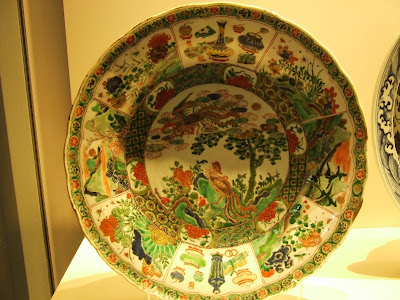
Above: Dish China late 1600s or early 1700s. Porcelain decorated with famille verte (enamel colours of predominately green and red) From the Powerhouse Museum Sydney.
It seems the influence of this style is often seen today in dishes and ornaments of inexpensive giftware.
Above: Blue and White Late Ming dynasty dish, China, early 1400s.
This is a fine example of blue-and -white porcelain made in Jingdezhen, Jiangxi province, which was the site of China's imperial porcelain kilns. Chinese Blue-and -white procelains, often of a lesser quality, were imported into Europe on ships of the Dutch and English East India compaines, established in the early 1600s to share in the rich spice trade.
From the Powerhouse Museum.
Two ornamental vases Tin glazed delftware (eathenware), decorated by Gerrit Pietersz Kain at his De Drye Verguilde Astonnekens factory, Delf, Holland, about 1680. Like generations of potters, many European factories imitated imported Chinese -and, from the late 1600s, Japanese- designs. They used earthenware covered with an opaque tin glaze that resembled the white porcelain they so admired but, except for a few factories, were still unable to make in the mid 1700s.
From the Powerhouse Museum.
One of these teaposts is a fake. Can you guess which one?
As interest in antique porcelain collections grew in the late 1800s, some potters copied antique objects and forged marks on them to achieve higher prices. The famous maker of such fakes was Emile Samson.
Knowledge of antiques was limited and it was easy to deceive customers. Not many would notice, for example, the give-away bright-white colour of hard-paste porcelain in Samson's 'Chantilly' teapot (15) - only the warmer toned soft-paste was made at the French factory.

15 Teapot Hard-paste porcelain, painted with Kakiemon 'two quail' pattern at Samon et Cie, Montreuil, France, about 1900. Chantilly mark (red hunting-horn) painted on base.
16 Worcester Teapot Soaprock porcelain, transfer-printed, handpainted and gilt with 'Chinese family' pattern, Worcester Porcelain Factory, England, about 1770.

The introduction of transfer-printing to porcelain decoration in 1756 meant that decorated articles could be produced economically. Early Worcester teapots showed strong Chinese influences. Later designs were often based on French engravings.
From the Powerhouse Museum.

From the Australian Broadcasting Corporation correspondent Warren Duncan: Workers queue for a breakfast of noodles at a side walk cafe in Wuhan

Wednesday, August 20, 2008


Laying water pipes
Lu Shuan-chin
Commune member
Gouche 890 x 1230 mm
From exhibition: Peasant paintings from Hu county, Shensi province, China.

Dragon boat races on the Mekong River in Yunnan province. From an early correspondent: Warren Duncan

Saturday, August 16, 2008


China's model terraced commune at Tachai in Shenshi province. Photo from an early correspondent: Warren Duncan.

Imparting experience
Li Chou-cheng

This is part of what the Chinese once called 'open-door' science.
'... processes of face-to-face contact and exchange appear to be exceedingly important in the transmission and popularization of science in China. Because such exchange generates little or no printed material, western observers, who tend to believe that all scientific communication of any note eventually reaches print, are likely to over-look what appears to be a vast network of informal scientific exchange in the Chinese countryside.' China: Science Walks on Two Legs. New York. 1974. p 48.
From a British exhibition: Peasant paintings from Hu county, Shensi province, China.

Friday, August 15, 2008


'A noisy political street march in Peking' Photo from an early correspondent Warren Duncan. Those were the days, no political street march passes by the Mattress (or Ice Cube) now.

Tuesday, August 12, 2008


'The spirit of Yenan shines brightly always.' is written on the chimney.
On the Kiln: 'Tawang commune brick-kiln factory.'
The Commune Brick-kiln by Chang Min-wu.
Quote from the card: Yenan was a small town in Shensi province where the communists established their base area at the end of the Long March. Here many of the principles of the Chinese revolution were worked out in practice over a long period (1935-48) for the first time.

From the exhibition: Peasant paintings from Hu country, Shensi privince, China, Arts Council of Breat Britain.

Friday, August 8, 2008


Information about this Chinese art refers to Dunhuang in the Western Region where caves have many examples of ancient grotto art.
The area was the hub of three roads leading to the West and of the Silk Road which resulted in a blend of influences and Chinese Buddhist art reached its apex there in the Tang Dynasty so long ago. A treasure trove of coloured murals were also found there.
The Tang figures are very amiable. The kneeling figure is that of a devotee. Mid-Tang (762-820) and the other is of a bodhisattva also Mid-Tang.
From China Pictorial, Beijing, 1980.

Thursday, August 7, 2008


Eight Stallions, a painting by the Jesuit priest Guiseppe Castiglione (1698-1768), who became one of the imperial painters in China and famous for his horse paintings which he signed with the
name Lang Shih-ning.
From an old journal Orientations, Pacific Communications, Hong Kong.
..the horse....speed and perseverance, noted for its proud bearing, its fiery impulsiveness and its intelligence.

Here was a Mediterranean European Jesuit in old China. It is stranger than fiction. I don't think his work has the same flair as the Chinese artists but is a curiosity all the same.

From the article: The Chinese Lunar Calendar follows a 60-year-cycle, in which each year is given a specific name. Each year is denoted by the combination of the five elements (metal, wood, water, fire and soil) and especially devoted to an animal of the 12-animal cycle. ...How this cycle came to be, what animals were chosen, and how, is a little story in itself. It was Buddha who decided, long ago, to summon all the animals of the world and grant them a special gift each. As it turned out, only 12 animals showed up. To each of them, he gave a year to reign so that each year would take on the specific character of the reigning animal. As each animal arrived, so his place was decided in the cycle. They came in this order: rat, buffalo, tiger, hare, dragon, shake, horse, goat, monkey, rooster, dog and pig.
Is there any connection between the spiritual world of a people and the political ideology they live with? It is obscure.

Wednesday, August 6, 2008


Yueh ch'in also know as a moon guitar, this Chinese instrument was acquired by the Powerhouse Museum ( or its forebearer) in 1884. It is still in perfect condition.


From Powerhouse Museum, Sydney, tracing the Chinese presence, which is longstanding, in Australia.
San hsien (hanging): wood, snakeskin and bone, China, about 1880.
Jinghu and bow (hanging): wood, snakeskin and horsehair, China, about 1880.
Tye or dizi (flute) (rear): bamboo and bone, China, about 1880.

Wednesday, July 30, 2008

Reflecting on all sides....
Mysterious and hauntingly beautiful, this porcelain bust with its shadowry blue yingquing glaze is from the outstanding China series by Chinese-Australian artist Ah Xian.
Made in Jingdezhen, the centre of Chinese porcelain production since the Ming dynasty (1368-1644) each bust is differently decorated using traditional designs and glazes.
Bust 39 which was cast from a local girl whom Ah Xian met while developing the series, is decorated with a phoenix and peony design in low relief. Description by the Powerhouse Museum.
Donated by Doctor Gene and Brian Sherman through the Australian Government's Cultural Gifts Program.
From the Powerhouse Museum Sydney 2008

Wednesday, July 23, 2008


Many Ethnic groups are found in China, and is this charming image romancing their appeal.......romance........romanisation........ Chinese Mandarin is an ancient living language with pictographic writing and it once underwent Romanisation.
About fifty years ago the Chinese government established a standard official version (called Putonghua or Hanyu - language of the Han people - the majority people.
The amazing written characters were simplified and made easier to write (really!) and Romanisation saw the Pinyin system adopted to express the sounds of the language, for example via vowels etc. Another trick is that tones are used to express the differences in meaning of the same sound.
As well as the simplified characters those seen in newspapers, in books or in headings use slightly different fonts.
Traditional characters are more complex and unsimplified and might be seen used in Taiwan or in Hong Kong and in the global communities - probably used in the printed menu at the local Chinese Cafe. The characters are also seen in Japanese and in some Korean texts and in other instances of which I am unaware.
Each Chinese character is pronounced as a single syllable and has its own meaning. They are combined.
The other decorative cursive styles found in calligraphy make a beautiful art form.
Incredible examples of fine characters carved into stone slabs or steles are found preserved in collections - the Stele Forest is one that can be seen.
It seems that maps and place names underwent modernisation as well and dual versions can exist to test the wits, locations become quite unintelligible on certain maps.

Most of this information is from the book Ni Hao by Fredlein and Fredlein, published by China Soft, Brisbane, 2001. The little symbols for accents etc in above words have been omitted.

http://languagelog.ldc.upenn.edu/nll/?p=189 More complex discussion as to the key to learning Mandarin is on this link.